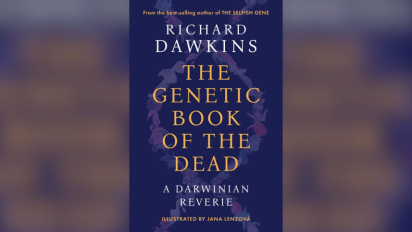
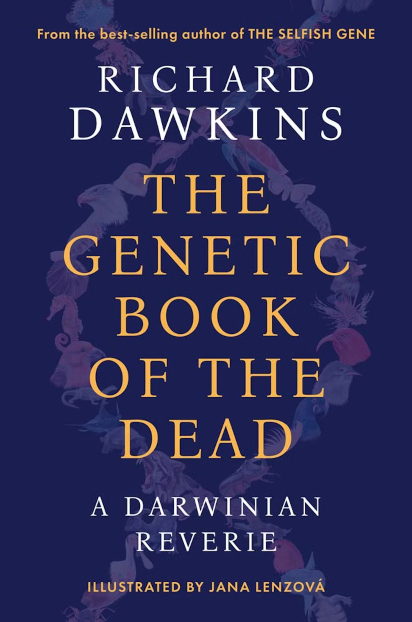
[Review] The Genetic Book of the Dead: A Darwinian Reverie
"Come to be pleasantly lost in Dawkins’s thoughts in this Darwinian reverie on natural history," our reviewer writes.
Despite its title, genetics isn’t the primary focus of Richard Dawkins’s new book until nearly the end. Instead, natural history is front and center in nearly every chapter, through not only the text but also a remarkable number of images and lovely full-color illustrations by Jana Lenzová. These images are nicely intertwined with the narrative: you won’t see a “(see Figure 1)”; instead, the text refers directly to the adjacent images, often in creative ways. Nearly every other page is illustrated, showing everything from the interior of a crab infested with the parasitic barnacle Sacculina to a fantasy image of a couple of chimpanzees making a stone wall in the same manner that caddisfly larvae stack rocks. I think the book’s essence is better conveyed by the subtitle, A Darwinian Reverie. A reverie, according to the online Oxford English Dictionary, is either “a state of being pleasantly lost in one’s thoughts” or (less often) “a fanciful or impractical idea or theory.” This book satisfies both those definitions.
 Dawkins is best known as the author of The Selfish Gene (1976), which besides popularizing the gene-centric view of evolution launched the now famous neologism “the meme.” (There are several more neologisms introduced in his new book.) The ideas of The Selfish Gene are summarized and updated in The Genetic Book of the Dead in chapter 8, “The Immortal Gene.” Similarly, The Extended Phenotype (1982) is summarized in chapter 9, “Out Beyond the Body Wall.” The Genetic Book of the Dead also rehashes the many examples of “bad design” in anatomy presented in The Blind Watchmaker (1986). In fact, if you haven’t read the Dawkins of old, much of it appears in the new book. To a younger generation, Dawkins has become a figure of controversy owing to his social media output related to sex, gender, race, and religion. Thankfully, his controversial attitudes aren’t reflected here.
In addition to his own ideas, Dawkins brings up older ideas in evolutionary biology, even obscure ones like the Baldwin Effect (a theory of how learned behavior can be incorporated into the genome), but misses the chance to talk about Dollo’s law (i.e., complex characters can’t re-evolve once lost) when discussing why whales and dugongs don’t have gills despite living in water. He also misses opportunities to reference modern concepts like coalescent theory, when discussing how the history of individual genes may not reflect the phylogenetic history of a group of organisms; unfortunately, he alludes to the once common idea that the majority of gene trees should reflect the true phylogenetic history of a group: those of us doing this kind of work know (to our frustration) that the majority of genes often provide a false history of the relationships of the organisms we are studying.
I say that the book is a little like “a state of being pleasantly lost in one’s thoughts” because Dawkins meanders through example after example of natural history almost as if he is telling stories while walking with a companion. The meandering is not unpleasant. I particularly enjoyed the explanations of the evolution of turtles and the evolution of some lineages into land animals and then back to an aquatic life. I was puzzled, however, by his stipulation that “to avoid tiresome repetition, I shall sometimes treat all living creatures as honorary animals” (p. 1). This usage of “animals” to cover all organisms including plants, fungi, bacteria, and archaea may confuse some readers right off the bat, and might offend the sensitive botanist, mycologist, or microbiologist. I’m not sure why he didn’t just use “organism” instead of “animal” in reference to all life on Earth.
I also say that Dawkins’s book fits the bill for the less-used definition of “reverie” (i.e., “a fanciful or impractical idea or theory”) because his central literary device is never quite convincing. The Scientist Of the Future, or SOF, is introduced as the protagonist, whose task is to understand the environments in which the ancestors of a given organism existed on the basis of its genome and its (extended) phenotype. Dawkins variously describes this basis as “the genetic book of the dead,” which contains “the description of ancestral worlds,” and as a “palimpsest,” which ordinarily means a document overwritten with superimposed messages written at different times; in Dawkins’s metaphor, the older layers of the message are in the genome while “the most recent scripts … are those written during the animal’s own lifetime.”
Thus, throughout the book, his natural history examples reinforce the point that an organism may look the way it does because of how its genome reflects the previous environments in which its ancestors lived. Those previous habitats may be the same as or different from its present habitat. As Dawkins puts it, “the animal [i.e., organism], including its genome, embodies a model of past environments, a model that it uses to, in effect, predict the future and so succeed … in the game of survival and reproduction, or more precisely, gene survival” (page 1). The problem is that, as he points out later in the same chapter, it is clearly not true “that existing science is ready to translate DNA sequences into descriptions of ancient environments. Nobody can do that, and it’s not clear that SOF will ever do so” (page 11). And that is the central idea of the book, an impractical theory.
But even if you don’t have a need for what you may see as his fanciful or impractical ideas, come to be pleasantly lost in Dawkins’s thoughts in this Darwinian reverie on natural history.
The Genetic Book of the Dead: A Darwinian Reverie
by Richard Dawkins
Yale University Press
Prosanta Chakrabarty, a member of NCSE’s board of directors, is E. K. Hunter Chair for Communication in Science Research, and Professor and Curator of Fishes, Museum of Natural Science, at Louisiana State University.