A new 12-year-old comic about the Scopes trial
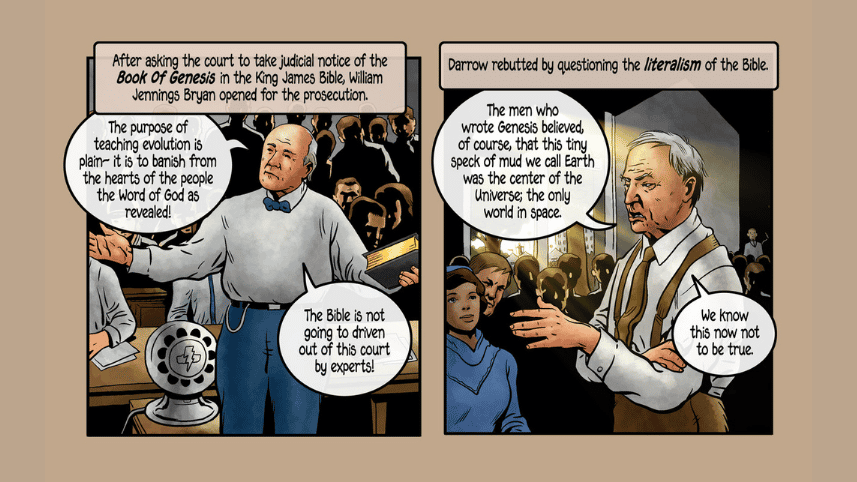
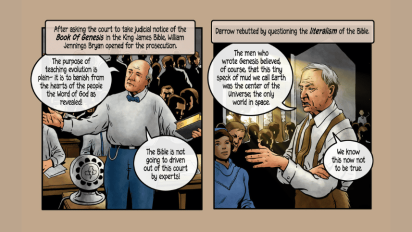
William Jennings Bryan and Clarence Darrow, from Rick Veitch and Steve Conley's "The Scopes Monkey Trial."
True-Man, a creation of the veteran comics artist Rick Veitch, “is a higher dimensional creature who has been captured by the CIA and brainwashed by MK-Ultra,” according to promotional copy for the collection True-Man the Maximortal Comics #1 (2024). “Seen as a way to upend world geopolitics, True-Man is being shaped and programmed into the ultimate apex predator. Meanwhile, a small group of those who care and those who fear organize to free him.”
Readers of True-Man the Maximortal Comics #3 (2026) might, therefore, have been a little puzzled by the inclusion of a straightforward 10-page treatment, in gray tones, of the Scopes “monkey” trial of 1925, narrated by the elderly John Scopes himself. (He alludes to the repeal of the Butler Act, so he must be between 67 and 70.) True-Man is conspicuous by his absence, and, with the arguable exception of Clarence Darrow, there is no ultimate apex predator to be seen in the courtroom.
“The Scopes Monkey Trial” is a mostly accurate, judiciously condensed, and effectively paced telling of the familiar story of the trial. William Jennings Bryan and Clarence Darrow, as the iconic antagonists, receive the bulk of the attention, with the acidic journalist H. L. Mencken coming close. A nice touch is the inclusion of Dudley Field Malone’s famous speech, which Bryan, Mencken, and Scopes all regarded as the most powerful in the trial; it is correctly described as drawing “extended applause.”
The artwork is also striking. The familiar (if misleading) series of marching hominids appears on the first page, with Scopes occupying the pride of place at its conclusion. Bryan and Darrow are repeatedly opposed to each other, just as they were in life. There is a lovely tribute to a legendary cartoonist: two framed editorial cartoons about the Scopes trial are shown in the background of one panel, and the lefthand cartoon, “Barnum Outdone,” is by Windsor McCay, best known for “Little Nemo.” 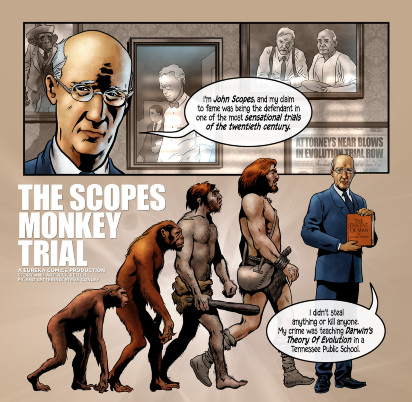
There are, to be sure, a few minor errors. The Butler Act was enacted in March, not February, 1925, and it remained on the books for 42, not 32, years. Bryan was napping, not dining, when he died a few days after the trial. Fredric March’s first name is misspelled on a poster for Inherit the Wind. These would be easy to fix; harder to fix would be Malone’s attire — although he had been wearing his suit jacket in the sweltering courtroom, he dramatically removed it before delivering his famous speech!
Overall, “The Scopes Monkey Trial” would plausibly be a useful tool for a high school history or social studies teacher discussing the culture wars of the 1920s. Presenting complex ideas and issues in a relatively simple and easy-to-understand way, with images complementing text and helping to engage interest, comics in general are a valuable useful complement to formal education. And certainly “The Scopes Monkey Trial” is no exception.
Interviewed by email, Veitch explained the genesis of the comic. In 2013, Veitch and his collaborator Steve Conley founded Eureka Comics, a developer of educational comics. In early 2014, they were trying to convince editors at McGraw Hill Education of the viability of such comics. They offered to produce a comic on a complicated topic as a proof of concept, and the editors selected the subject of the Scopes trial. Veitch and Conley set to work.
They didn’t have any special prior interest in or knowledge of the subject of the Scopes trial. “Like most other folks, we’d studied it in high school history class and had seen the films and plays” such as Inherit the Wind, Veitch commented. And, since it was just a proof of concept, they didn’t bother to consult any of the detailed scholarship or any of the recognized experts on the trial, instead relying on “what was available on the internet.” Veitch wrote the script, though under Conley’s “editorial eye.”
Asked “You must have learned a lot about the trial while you were working on the project. What really stood out to you as surprising or interesting or unjustly neglected?” Veitch responded, “We weren’t aware of how much the subject of evolution was still such a hot potato in some areas of the country.” Indeed, in 2014, there were no fewer than six bills aimed at undermining evolution education introduced in Missouri, Oklahoma, South Dakota, and Virginia, as NCSE previously reported.
In a bit more than a month, Veitch and Conley produced a full-color version of “The Scopes Monkey Trial.” When it was presented to the editors, “the light bulb went on in a lot of heads,” Veitch told The Comics Journal in 2022. He explained more recently: “When we turned in the finished story we almost immediately were given a contract for six graphic novels’ worth of material. They were a big hit!” (Other clients of Eureka Comics include PBS, Wired magazine, and the University of Quebec at Montreal.)
But “The Scopes Monkey Trial” never saw the light of day until True-Man the Maximortal Comics #3 was published. Although the bulk of the book is a superhero comic, as its title suggests, “its back pages are a showcase for the other types and genres of comics I have worked on, including educational pieces like [the] Scopes [comic],” Veitch explained. “The format doesn’t allow for color; hence the change to grey tones.” (The color images here are thus making their debut, with Veitch and Conley’s permission.)
Asked whether they were disappointed that it took 12 years for “The Scopes Monkey Trial” to be published, Veitch responded, “We have no regrets. In fact [the] Scopes [comic] did everything we asked of it by demonstrating how entertaining and enlightening comics could make learning history. We still show it to potential clients.” He added, “If a publisher wanted the rights to use it, we’d be happy to work out an arrangement.”