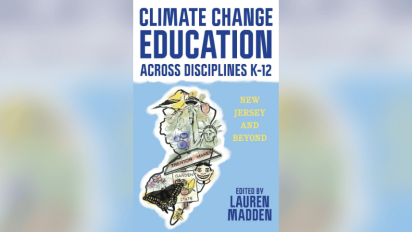
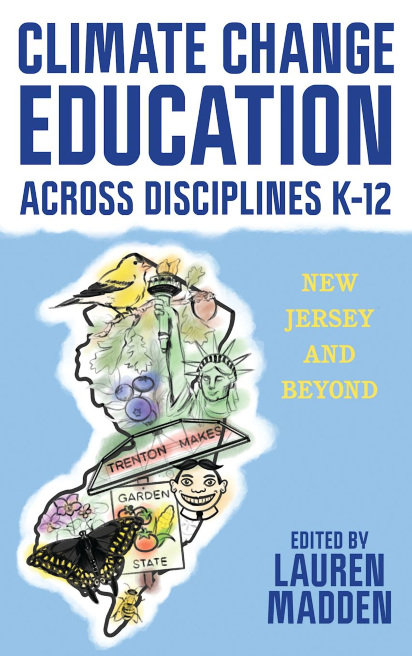
[Review] Climate Change Education Across Disciplines K–12: New Jersey and Beyond
"The chapters in this book clearly demonstrate how educators in every subject matter area and grade level can help children understand their relationship with the living world, and one another, in this historical moment," our reviewer writes.
Teachers in the state of New Jersey are navigating the early stages of an experiment to integrate climate change into K–12 curricula at every grade level and, perhaps more ambitiously, into every subject matter area. Transformations are happening fast in some Garden State classrooms, and educators on the edge of these shifts want to share lessons learned — including numerous small victories as well as the inevitable frictions that arise from systems-level shakeups and individuals reassessing their own professional roles. Editor Lauren Madden has assembled a big-picture set of chapters, authored by those with first-hand experience in changing their parts of the educational ecosystem. The table of contents shows a variety of actors who aim to influence the learning of young children and adolescents; these include teachers at all grade levels, school counselors, librarians, non-formal educators, parents, administrators, and policymakers. Many of the most inspirational passages in the book document how these folks interacted to dream big and started testing out new visions of student engagement within their schools and communities.
 Across chapters, authors share a variety of climate literacy and sustainability projects they have put into action. These range from mock UN Assemblies for secondary students to “mindful walks” and “data walks” in the local park by second graders. Although it may be tempting to head right to a chapter about your own grade level or subject area, there is a lot to learn by seeing how important themes come to life in different ways throughout a K–12 curriculum (e.g., what it means to be resilient, to think critically about one’s relationship with the land, to express feelings through the arts). In my own reading, I found that most chapters highlighted learning strategies or broader approaches to climate, environmental change, and solutions that could inform the design of student experiences at all grades, inside or outside of school. These include working with students’ emotions, unpacking socio-scientific issues related to sustainability, fostering eco-justice awareness, and the role of Indigenous worldviews in re-thinking our relationality with the natural world.
Authors of the chapters on pre-school and elementary learning wisely set up foundational principles about living systems that could be built upon in later grades. For example, students are introduced to the idea of Earth as a unique place where habitats are “just right” for certain species to thrive in, and that plants, microbes, and animals are adapted to these conditions. These teachers model respect for the environment and engage students in wildflower walks, vermicomposting, the use of rain barrels, and re-use or re-purposing of everyday materials. My favorite vignette about children taking action comes from a mom who described her son’s latest project: He had stuck every drill bit and screwdriver he could find into the ground in the back yard and informed her that these were “cooling sticks, sucking up hot air in the Earth and sending it back to the Sun.” Taken together, these early years’ explorations can have a cumulative effect, laying the groundwork for conversations of increasing nuance over time about sustainability, human impact, and justice for all species as well as for future generations.
I noticed that multiple authors mentioned the importance of critical thinking, and in two chapters this construct was clearly defined. In other chapters, the term seemed to reference various kinds of intellectual work specifically tied to climate change, like wrapping one’s head around wicked problems that seem impossible to solve, dealing with uncertainty in data, fostering a critical consciousness about the origins of our damaged landscapes, the modeling of multiple possible futures, and analyzing how complex socio-scientific systems are entangled in our planetary crises. Several chapters make clear that all these challenges are well within the grasp of K–12 learners and indeed are necessary to deeply understand the interplay of climate change, solutions, risk, and justice.
My final thought — which is not a criticism of this important book — is that we may need to understand better the stories of educators who, for whatever reasons, did not get into the game. Around the country, these folks outnumber those who commit to addressing climate realities with students. Under what conditions would those individuals now on the sidelines feel comfortable and empowered to begin conversations with learners about humans’ role in planetary change, excessive consumption, or sustainable futures? In other words, can we help them find a “way in”? We need to normalize the broad involvement of adults in our educational systems and local communities to address these challenges together, because overdependence on a deeply passionate few to take up this work is unsustainable and inequitable. Currently, too many teachers maintain that our changing climate does not relate to their disciplinary specialties, but the chapters in this book clearly demonstrate how educators in every subject matter area and grade level can help children understand their relationship with the living world, and one another, in this historical moment.
Climate Change Education Across Disciplines K–12: New Jersey and Beyond
Edited by Lauren Madden
Rowman & Littlefield

Mark Windschitl is Professor of Science Teaching and Learning at the University of Washington and the author of Teaching Climate Change: Fostering Understanding, Resilience, and a Commitment to Justice (2024).