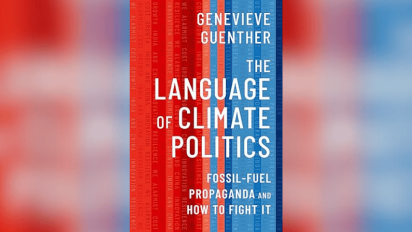
[Review] The Language of Climate Politics
I don’t usually write book reviews, but I welcomed the opportunity to review The Language of Climate Politics by Genevieve Guenther. The subject is an important one, namely how we talk about the climate crisis, especially to those who do not accept the science of climate change. And the book’s clear and fresh style made for easy reading.
The book deals with climate politics, fossil fuel propaganda, and climate denial — favorite topics of mine, and topics in which I believe many other readers will be interested too, as the climate crisis is a threat to us all. Fossil fuel propaganda has created climate denial, which has been a major force in stopping the adoption of effective climate policy. This political battle is fought with words and, so far, the propaganda has been winning.
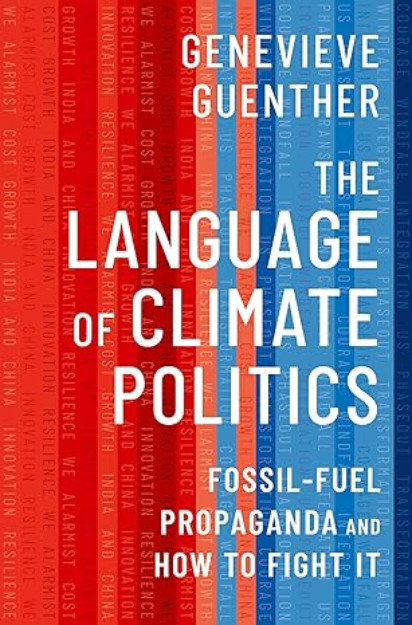 At the beginning of her preface, Guenther identifies the culprits: those “who are happy to destroy a livable climate to gain more profit and power,” She later states “there are millions of other people, some of them running the world, who seem willing to destroy civilization … so that the fossil-fuel system can continue now.” And in the introduction, she outlines how the propaganda of the fossil-fuel industry manipulates us and U.S. politicians, especially Republicans but also Democrats. The book describes how to recognize this manipulation and proposes using language to fight back.
The first chapter offers a discussion of how different groups see climate change, including alarmists, doomers, and climate scientists. This section concludes with a proposal of how to properly discuss the problem of climate change with a view to ending the use of fossil fuels. The category of climate scientists in the middle of the chapter appeared out of place to me, as this is a profession, not an opinion, and the other groups covered are generally reacting to, not producing, the climate science.
The next five chapters focus on the major topics used to derail climate legislation, namely high costs, lower GDP growth, the growing emissions of China and India, the idea that innovation is the solution, and the false notion that resilience and adaptation will protect us from the perils of climate change. Guenther brings together, in a straightforward manner, how these complex issues are promoted and abused by the propaganda against effective climate policies.
I especially enjoyed the sections on cost and economics, some of it new to me. As a side note and pet peeve, however, I note that many of the economic studies on which Guenther relies seem to have been written without the aid of a climate scientist. I have always wondered how such studies can be written without a climate scientist being co-author, since climate scientists are the specialists who produce the projections on the impact of climate change. I was also skeptical of her doubts concerning carbon pricing. Living in Canada, I have seen what a political nightmare even a fee-and-dividend program like ours has been. Nevertheless, carbon pricing is still a recommended climate policy.
Also, there is more to the phrase “common but differentiated responsibilities” in the United Nations Framework Convention on Climate Change than appears in Chapter 4 of the book. I discussed the debates about the phrase during the early COP meetings in my Carbon Politics and the Failure of the Kyoto Protocol. Despite years of these high-level meetings on the meaning of this phrase, no agreement has been reached on the exact definition. The statement, though, has less importance now, since nations have simply moved past the ambiguity of this phrase.
The last section, consisting of only a few pages, may be the most important. Here an easy-to-grasp summary of the language to use in a variety of circumstances is presented, along with a call-to-arms to go out and use the language. To deal with climate change, you cannot be passive, and you cannot be silent. Words are powerful in this debate. We need to talk about climate change and the issues raised by climate denial with our family, friends, and co-workers, and Guenther teaches us how to do this.
Will similar language work with politicians? Guenther believes that it will. A fear of mine, though, is that if language, no matter how well designed, gained political traction, a tsunami of propaganda from the fossil fuel industry and the climate denial movement would drown it out. That said, we must try.
Overall, the message in The Language of Climate Politics needs to be heard. Choosing the right words and new phrases, and finding common ground, to discuss climate change are good steps to take.
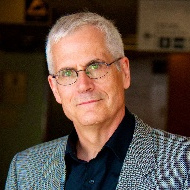
Gerald Kutney is a commentator on the politics of the climate crisis. He is the author of two books, Carbon Politics and the Failure of the Kyoto Protocol (Routledge, 2014) and Climate Denial in American Politics (Routledge, 2024).