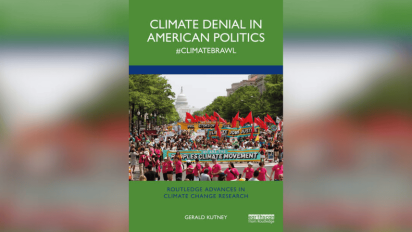
[Review] Climate Denial in American Politics: #ClimateBrawl
Gerald Kutney is best known for his work as a commentator and activist on climate change issues, and especially for his “#climatebrawl” efforts to engage and defeat climate denial narratives on social media. He defines climate brawling as “not a cordial discussion” but an attempt to “discredit the hard-core climate deniers, their propaganda, and their sources.” These targets, of course, are part of a climate change counter-movement, mainly organized through conservative think tanks that provide false expertise and disseminate doubt about climate science. It is purely a political response to a threatening global environmental social movement.
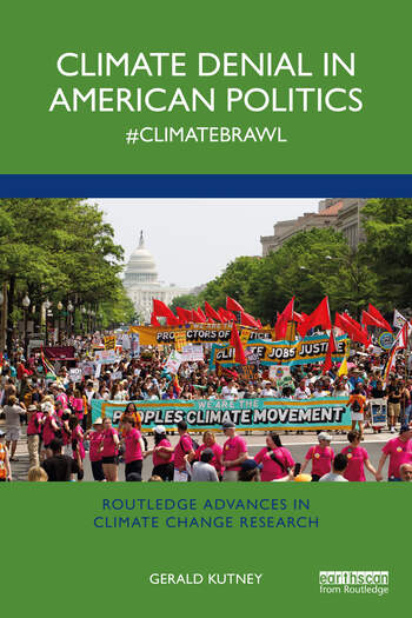 Kutney’s book Climate Denial in American Politics is confrontational in two ways: first, in recommending the active confrontation of climate denial claims on Twitter/X (the “brawl”), and second, in exposing climate denial in the US government.
Confronting speech that is harmful — “counter-speech” — and is something that political scientists and philosophers are considering more deeply as social media provides an effective vector for harmful speech, such as posts fomenting violence. This is in line with but goes beyond Judge Louis Brandeis’s statement that “the remedy to be applied” to dangerous expression “is more speech, not enforced silence” (Whitney v. California, 274 U.S. 357 (1927), concurring). Clearly, this approach is not for everyone — I personally do not see such engagement as productive and it would be an unnecessary stress in my life I do not need — but Kutney thinks this kind of debate should be used in places like the halls of Congress.
And I might be in the wrong. I abstain from political speech online to avoid senseless hostility. However, political theorist Jeffrey Howard (in a 2021 paper entitled “Terror, Hate and the Demands of Counter-Speech”) argues that “the samaritan obligation, held by all moral agents, to rescue others from risks of harm” generates a duty to respond to harmful speech. Howard puts it this way:
Such duties require whatever is necessary and proportionate, provided it is not unreasonably burdensome, to rescue our fellow human beings — to swim, jump, punch or even kill. My novel proposal is that samaritan duties also sometimes enjoin us to speak. (emphasis in original)
However, the duty to speak only obtains if the counter-speech will matter, something unclear in the literature thus far.
I depart from Kutney because the idea of defeating denial speech through other speech assumes a rationality I do not think inhabits denial discourse. Climate denial is unfazed by rational speech acts because it is ideologically led. Ideology, discussed only at a superficial level in the book, is a sense of the good life along with a political program to achieve it. When ideologues cannot imagine why someone has a different sense of the good life, ideology dictates what is allowed to be true. The climate change countermovement is ideologically led, and the hard-core deniers inhabit a reality that does not need to be rational. Inasmuch as climate action threatens conservative idealogues, they are also reacting in fear of the loss of this reality, and fear is also not centered in reason. For this and related issues, Climate Denial in American Politics is not where you should turn for climate denial social science.
Still, the comprehensive historical part of the book is strong. I have studied the organized rejection of climate science for over 20 years, and nevertheless I learned a lot. As noted in the section on methodology, this part of Kutney’s book was built on searching www.govinfo.gov (which provides access to official publications from the U.S. federal government), with particular attention to congressional hearings about climate change. I think that this is why Kutney is able to present new information, because this has not really been done in the literature on climate denial before. The intent of the book is in part to “show how endemic and entrenched climate denialism continues to be in Washington and how to break through the policy malaise.” On this front, the book is successful, and I have to admit, I did not realize just how deep the everyday rejection of climate science in Washington went.
The book is also a memoir of Kutney’s efforts to challenge denial on Twitter/X and a tactical guide for those who would join him. He provides examples and suggestions for responding to climate denial claims based on his experience of fielding so many. He relates that he originally adopted a “defensive” strategy, providing peer-reviewed evidence against climate denial claims, but then found that the debates degraded into a continuous loop of “nuh uhs” that fueled conspiracy and doubt. More effective, he suggests, is his “offensive” strategy:
DENIER: “The science is wrong.”
ME: “Share the peer-reviewed evidence that states this.”
DENIER: “Well, this meme shows that the science is wrong.”
ME: “Still waiting for your peer-reviewed evidence.”
DENIER: “Peer review is just pal review.”
ME: “Your tweets betray your character and credentials; no need to engage further.” (page 29)
The above example is schematic, but Kutney provides specific suggested answers to denial claims, which for readers who want to engage in this sort of interaction is probably useful.
Kutney acknowledges the criticism that “feeding the trolls” provides an unnecessary stage for climate change denial; however, he believes the misinformation must be addressed and confronted. Thus, he created the #climatebrawl hashtag as a “Bat-Signal” to alert others that a denial debate is afoot and to attract help. At the same time, he admits that not everyone wants to sign up for such a “toxic engagement.” Thus, Kutney is more permissive than Howard’s universal samaritan demand would be, but he clearly wants to neutralize the imminent harm created by the climate change countermovement, which is commendable.
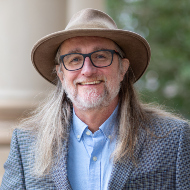
Peter J. Jacques holds the Rechnitz Family/UCI Endowed Chair in Marine and Environmental Law and Policy in the Department of Political Science and Sociology of Monmouth University. He is also Affiliated Faculty of the Urban Coast Institute.