
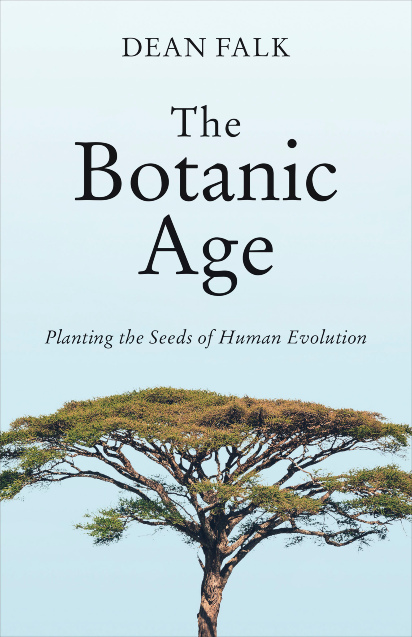
[Review] The Botanic Age: Planting the Seeds of Human Evolution
"Falk tackles a tricky topic — assembling indirect evidence for ideas for which there is no direct, “hard” evidence — and makes a compelling case for the importance of botanical resources in the earliest part of our evolutionary trajectory," our reviewer writes.
Falk aims to illuminate ancient behavior from the first three million years of human evolution, starting from about 6.5 million years ago, during which we have no record of tools made from stone — no small feat. She posits that before the Stone Age began there was “The Botanic Age,” as she dubs it, during which our ancestors made the first tools — nests, slings, and baskets — with perishable plant-based materials by weaving and woodworking. Relying on diverse fields of scholarship including comparative primate studies and ethnographic research, and often taking a feminist anthropology perspective, Falk also focuses on the mother–infant bond as key to the evolution of the neurological capacities for our species’ advanced intelligence and cognitive abilities, eventually leading to creative behaviors and technological inventions, including language and music.
 In chapter 1, “Baskets in the Trees,” Falk introduces our shared ancestry with great apes and reminds us that our earliest ancestors probably inherited manipulative abilities and a propensity for the frequent use of natural materials as tools from the common ancestor we share with our closest living ape cousins, chimpanzees and bonobos. She emphasizes the shared behavior of constructing sleeping nests daily, mainly in trees, across all great apes (chimpanzees and bonobos, gorillas, and orangutans), describing great apes’ sleeping nests as “stationary tools” (page 13). In chapter 1 she also introduces the concept of “folk physics,” intuitive understanding of cause and effect in the natural world, and reviews experimental psychology research on whether chimpanzees possess this understanding (she thinks that they do and that our earlier hominin ancestors — extinct species more closely related to humans than any other living ape — did too).
In chapter 2, “Baskets Go to Ground,” Falk reviews the fossil evidence for the gradual evolution of bipedalism in hominins and situates this adaptation in the environmental context of the time: cooling global temperatures leading to forest fragmentation and the spread of more open, dry savanna grasslands in Africa. She suggests that the need to collect botanical resources — including those for daily nest-making — that were now more spread out may have led to more frequent upright walking across grassy areas carrying nest-making materials. Eventually these early ancestors would have built more night nests on the ground instead of in the trees as they started generally spending less of their waking hours in the trees and more on the ground.
In chapter 3, “Did You Make Your Nest This Morning?”, Falk points out that because male hominins had larger body sizes than females, they likely made their sleeping nests on lower, larger sturdier branches or on the ground near tree trunks — similar to what some larger male chimps and gorillas do — so they probably led the trend towards terrestrial sleeping. She posits that fully terrestrial sleeping probably evolved by about 1.5 million years ago with early Homo, leading to males and females sleeping together near their offspring to protect them from nocturnal terrestrial predators — the threat of which she suggests may have led to frightening dreams and nightmares. Falk reviews modern human sleep stages, patterns, and durations, including those of peoples in traditional versus Western societies. Comparing the 6–7 hours we modern humans sleep per night on average to the 10–12 hours per night that chimps sleep, Falk suggests this shortened sleep led to lower risks from both dangerous predators and disease-transmitting mosquitoes.
In chapter 4, “From Tree Nests to Baby Carriers,” Falk outlines how with the evolution of bipedalism and the likely loss of a continuing covering of body hair, more helpless nursing infants would have suffered lethal falls because they could not cling with all four hands (and feet) to their traveling mothers’ underbellies like ape and monkey infants do. She thinks this prompted the invention of baby slings, which she hypothesizes were among the first widely used portable tools hominins created and were made with techniques similar to the interweaving strands of vegetation undertaken to make sleeping nests. She reviews the variety of materials and techniques used (overwhelmingly by women, who also do much of the carrying of other heavy loads) universally across cultures to create slings and other baby carrying devices.
In chapter 5, “First Came Wood, Then Came Stone,” Falk introduces the later indirect and direct archaeological evidence for the use of twisted fibers to make textiles and other wooden artifacts such as cradles, canoes, and wheels — all used to transport things. She reviews evidence for Early Stone Age lithic tools, and notes some evidence that these tools were important for making other wooden tools. She describes the use of sticks, wood, bark, leaves, and rocks in chimpanzees, which is mainly to obtain food, such as cracking open nuts, hunting smaller primates, and digging for tubers. Introducing archaeological evidence for wooden hunting spears, she touches on the sexual division of labor seen in chimpanzees (males generally doing more hunting, and females generally doing more extractive foraging) and suggests a continuity with a similar sexual division of labor in our own lineage.
In chapter 6, “Babies Fall, Language Rises,” Falk argues that females did much of the inventing in our evolutionary history, especially when it comes to “the most game-changing innovation of them all: language” (page 6). She reviews her previously outlined “PTBD” (putting the baby down) hypothesis for the origin of language, which is that vulnerable infant-directed vocal and gestural communication from prehistoric mothers eventually resulted in the emergence of ‘baby talk’ and then simple language. She suggests when ancient bipedal moms put down their arm-cradled babies while foraging, the babies would have complained with gestures and cries and the moms would have responded with their own gestures and soothing vocalizations, probably picking their babies up when doing so. She links these ideas to changes in our throats and brains (such as the descent of the larynx) leading to evolution of human speech. She also suggests that the sound of rhythmic bipedal walking during gestation and the first few years of life, along with melodic baby talk, would have eventually led to the invention of music.
In chapter 7, “What’s Hobbit Got to Do with It?”, Falk extends the idea of baskets in the trees (arboreal sleeping nests) to baskets on the ground (terrestrial sleeping nests) to baskets on mothers’ hips (baby slings) all the way to sort-of baskets floating across oceans (trees that can be uprooted during severe weather, blown by high winds, and unintentionally raft across large bodies of water carrying unsuspecting animals on them), suggesting this solves the mystery of how the hominin species Homo floresiensis arrived on the island of Flores in Indonesia — perhaps while they were sleeping in trees. Falk discusses the earliest deliberately built watercraft, and how boats are implicated in human colonization of Australia and the Americas. She ends with a short review of the earliest known paper and writing.
In the conclusion, Falk summarizes the development of botanical and lithic tools and provides examples of the deep connection between humans and plants as evidenced in folklore, religious tables, and appreciation of botanical habitats and creative arts. She ends by suggesting that widespread geometric patterns in both modern and prehistoric art supports the idea that weaving and basketry were the first crafts and have been handed down from millions of years ago through today. After the conclusion, the book includes 40 pages of engaging interviews with eight people whose scholarship and knowledge Falk incorporated into the rest of the book, along with references and notes.
In sum, this is a clearly written, engaging, and easily readable book. Falk tackles a tricky topic — assembling indirect evidence for ideas for which there is no direct, “hard” evidence — and makes a compelling case for the importance of botanical resources in the earliest part of our evolutionary trajectory.
The Botanic Age: Planting the Seeds of Human Evolution
by Dean Falk
University of Toronto Press

Briana Pobiner is a paleoanthropologist at the Smithsonian National Museum of Natural History. She received NABT’s Evolution Education Award in 2024 and NCSE’s Friend of Darwin award in 2021.