[Review] What Teachers Want to Know About Teaching Climate Change: An Educator’s Guide to Nurturing Hope and Resilience (Grades K–12)
"What sets this book apart is that it functions as a practical, teacher-friendly, one-stop-shop for climate education," our reviewer writes.
A recent survey from the Yale University Program on Climate Change Communication found that nearly 80% of respondents, from across the political spectrum, said that they “somewhat or strongly agree that schools should teach about the causes, consequences, and potential solutions to global warming.” And across the country, state science standards expect (albeit with substantial variance) that climate change will be taught in the K–12 classroom. However, other recent data shows that teachers, despite wanting to teach their students about human-driven climate change, believe that they lack the expertise and/or resources to do just that. Further complicating the picture is that some teachers worry about receiving complaints from parents if they were to teach about climate change in their classrooms. The result of all of this is silence or reticence about climate change in the classroom in many parts of the U.S. Given all of this, it is critical that K–12 educators have clear, comprehensive resources to teach climate change in their classrooms, such as the book What Teachers Want to Know About Teaching Climate Change by Bertha Vazquez, Kimi Waite, and Lauren Madden.
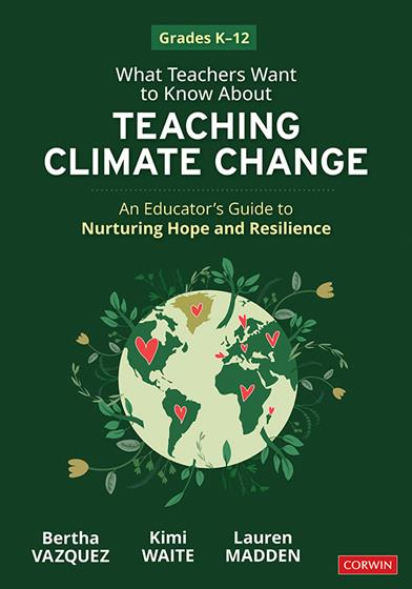 As an educator with experience teaching climate change at both the K–12 and college level, I find this book to be an excellent resource for K–12 teachers, regardless of their level of familiarity with the science of human-driven climate change. The book clearly distills the most critical scientific facts, such as the overwhelming consensus about human activity as the major driver of climate change, and places those facts within a larger scientific and pedagogical context. Simply put, there are a lot of resources available for teachers who want to teach climate change, but finding those resources and subsequently assessing whether they are appropriate for a particular lesson or classroom can be overwhelming. This is especially true for time-strapped teachers already juggling packed schedules filled with meetings, student support, grading, and lesson planning.
What sets this book apart is that it functions as a practical, teacher-friendly, one-stop-shop for climate education. The table of contents is thoughtfully structured so teachers can easily navigate to the sections most relevant to their needs. Chapters are framed around common questions teachers might ask, such as how to introduce climate change into the classroom, how to address student anxiety, and how to discuss real-world solutions and scientific practices like data literacy and graph reading. This question-based format not only meets teachers where they are but also models an inquiry-driven approach central to scientific thinking.
The book’s utility is further enhanced by helpful structural features. Each chapter includes sections such as “Learning from Our Colleagues,” “Reflection Questions,” and “For Further Reading.” These elements serve both as professional development tools and ready-made classroom discussion prompts. I particularly appreciated the flexibility of the reflection questions — they are designed to support teacher learning but can also be used directly with students to spark classroom conversations.
The authors highlight success stories from real classrooms in color-coded boxes, making it easy to find examples of how other educators have implemented climate change lessons. These stories help build a sense of community and offer practical inspiration. Additionally, the authors consider multiple scales of educational planning, from individual lessons and classrooms to curriculum-wide and even district-level implementation. For example, chapter 7 provides valuable insights into aligning climate change education with the NGSS and other national standards.
Finally, the appendix offers a well-organized compilation of online resources. This teacher-centered feature ensures that when educators need to revisit a useful tool or article, they don’t have to flip through the entire book — they can quickly scan the appendix to find what they need.
As a scientist who studies climate change and discusses climate solutions with my college students, I highly recommend this book for educators at all levels. In fact, I plan to use several of the featured resources in my own college classroom because of how effectively the book presents and contextualizes them.

Ramesh Laungani is associate professor of environmental science at Marist University and one of NCSE’s inaugural Sound Science Fellows.