Socioscientific issues are topics or problems with a scientific dimension that cannot be adequately addressed with scientific information alone. Some current examples include climate action, applications of artificial intelligence, vaccination policy, genetic testing, and animal research. Decision making about socioscientific issues requires integrating scientific information with other ways of knowing. These other ways of knowing include values, beliefs, ethics, and moral reasoning as well as consideration of other dimensions of the issue including cultural, social, philosophical, political, theological, economic, etc.
Rapid technological advancements, social change, and increased access to information via the internet have made socioscientific issues more important than ever in our modern society. Our position at the National Center for Science Education is that effective science education must specifically address socioscientific issues. Our position reflects the goals of the National Research Council’s Framework for K-12 Science Education (2012) that K-12 education should prepare students to “engage in public discussions on science-related issues, to be critical consumers of scientific information related to their everyday lives, and to continue to learn about science throughout their lives” (p. 9). NCSE’s DataWISE tool was designed to support students in developing the data literacy and media literacy skills necessary to analyze socioscientific issues discussed in the media.
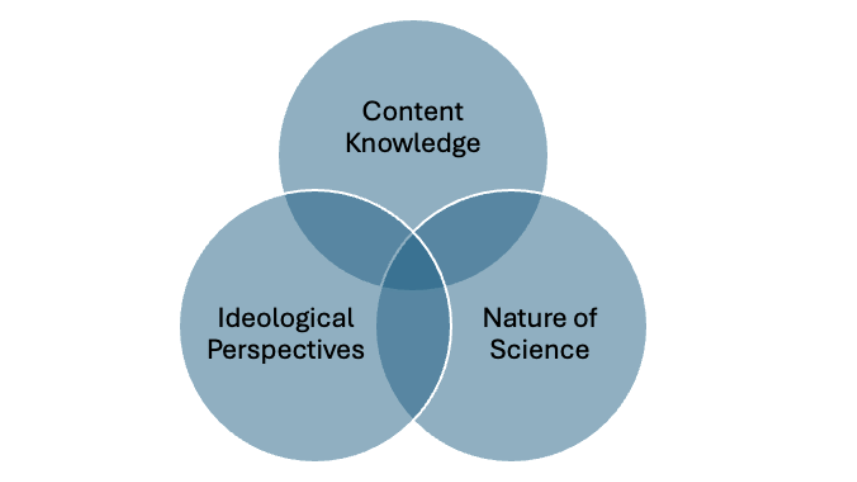
Any question about a science topic that could be stated as “Should we…” is a socioscientific issue because science alone cannot answer questions about what people should do. The scientific aspects of the issue include current expert consensus in the relevant scientific field (content knowledge) as well as relevant aspects of the nature of science. The nature of science refers to the methods, practices, and norms for producing scientific knowledge and an appreciation of its limitations. Science is limited to describing how the natural world works based on observable evidence, so when we ask what people should do with that knowledge, we are introducing ideological considerations. Ideology is often used to refer exclusively to political or religious perspectives, but we are using it here in its broadest sense as a “systematic body of concepts especially about human life or culture” (Merriam-Webster Dictionary).
When educators engage students in learning about socioscientific issues they must attend to student reasoning in all three domains: ideological, content knowledge, and the nature of science. This is a very challenging knot to untangle! Students have difficulty expressing their own ideas and often have little understanding of where those ideas come from. At the same time, they may hold misconceptions about the content and/or the nature of science, and they may hold ideological positions that differ from their peers or the teacher.
We have found that a Venn diagram representing the relationships among these three domains to be a helpful model for beginning to untangle these knots. In our professional learning workshops, we invite teachers to complete the Venn diagram model for their “typical student” and/or a certain type of challenging perspective around a specific topic such as human evolution or climate change. Teachers identify ideological perspectives, relevant content knowledge and misconceptions about those topics, and students’ understanding and/or misconceptions about the nature of science. We challenge teachers to consider how those ideas interact (the overlapping areas of the Venn diagram) to result in cognitive dissonance or reinforcement of ideas. Teachers have shared that they find this exercise very helpful to better understand their students’ thinking and how to respond effectively.
How do I handle ideological perspectives that conflict with science in the classroom?
Considerations for Teaching Evolution
Evolutionary theory explains the unity and diversity of life and is based on many lines of evidence. However, there are common misperceptions in the general public that evolution is somehow more tentative, less testable, or fundamentally different than other scientific explanations. The most common conflicts with evolution arise from certain religious beliefs that view evolutionary theory as contradicting beliefs about God, human nature, or the age of the Earth. However, most religions do not perceive evolutionary theory to be in conflict with their beliefs because science and religion answer fundamentally different types of questions. Over the past 100 years, religiously motivated legislation aimed at weakening evolution education in schools has been repeatedly attempted in many states across the US, and in some cases these policies have been enacted. However, state and federal courts have repeatedly upheld that evolutionary theory is valid science and that ideological viewpoints such as “scientific creationism” and “intelligent design” violate the Establishment Clause of the First Amendment of the US Constitution and therefore should not be taught in science classrooms in public schools.
Resources for educators:
- Evolution Story Shorts are classroom resources for teaching evolution. Story Shorts are aligned to the Next Generation Science Standards and engage students in using authentic evidence while addressing common misconceptions. Two Story Shorts in particular have a lot of connections to socioscientific issues: The Human Story and Pathogens and Vaccines.
- These slides give a brief overview of the legal challenges to evolution education.
- This article uses the Venn diagram model to describe four different common perspectives on evolution.
- In classrooms where many students express religious concerns about learning evolution it can be helpful to lead a class discussion about this topic. We recommend the Cultural and Religious Sensitivity (CRS) Teaching Strategies Resource developed as part of the Teaching Evolution through Human Examples Project at the Smithsonian.
Considerations for Teaching Climate Change
The science is clear: Earth’s average temperature has increased over the past 100 years at an unprecedented rate and human activities that emit greenhouse gases are the main cause. The most common conflicts with climate science arise from ideological positions that perceive addressing climate change as a threat to political or economic perspectives. In the past, this often took the form of outright denial that climate change was occurring. As the evidence became more conclusive, denial tactics shifted to acknowledge the fact of global warming, while arguing that it was caused by natural factors or that it was not a serious problem. Today ideological resistance to climate science is often much more covert and focuses on presenting “all sides of the issue.” Common tactics include emphasizing individual responsibility for emissions while ignoring the systemic changes necessary to reach net zero, accentuating the benefits of fossil fuels, claiming the costs to reduce carbon emissions will cripple the economy, or arguing that meaningful policy changes are not politically feasible. Renowned climate scientist Katharine Hayoe explains it this way: “When it comes to climate change, science-y sounding objections are a mere smokescreen to hide the real reasons, which have much more to do with identity and ideology than data and facts.” In order to prepare students for public deliberation about climate change, science education must not only teach the basics of climate science, but also how to distinguish scientific data and explanations from ideological perspectives.
Resources for educators:
- Climate Change Story Shorts are classroom resources for teaching about climate change. Story Shorts are aligned to the Next Generation Science Standards and engage students in using authentic evidence while addressing common misconceptions. The “Sustainable Climate Solutions” Story Short directly addresses many of the socioscientific issues around climate action.
- Multiple DataWISE activities engage students in directly comparing scientists’ claims about climate change to ideological perspectives that seek to minimize climate action (See Evaluating Use of Fossil Fuels, Comparing Climate Claims, and Environmental Impacts of AI).
- This resource uses the Venn diagram model to represent challenges to teaching about climate change.
- 11 Do’s and Don’ts of Teaching about Climate Change is a brief summary of NCSE’s views on effective climate education.
Download a pdf of this article.